why water is polar: bent shape and bond dipoles
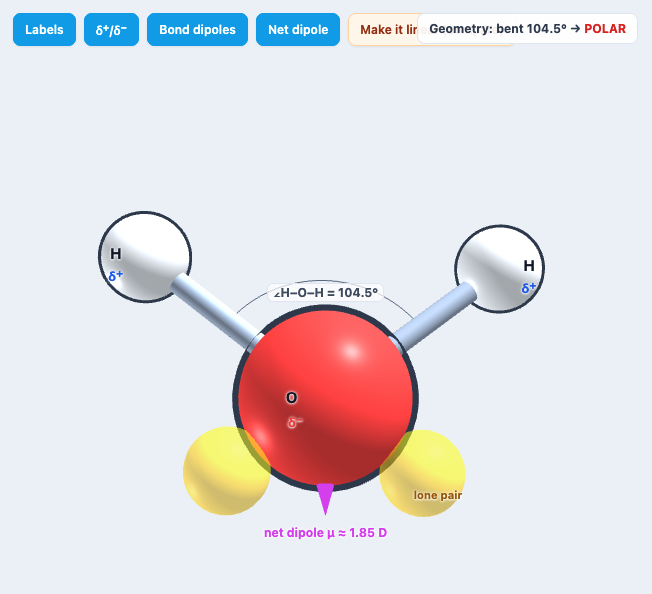
TL;DR: Water's bent structure (∠H–O–H ≈ 104.5°) prevents cancellation of polar O–H bonds (Δχ ≈ 1.24), resulting in a net dipole moment of μ ≈ 1.85 D, making it a polar molecule.
Question
Draw and label a water molecule. How does this structure result in water’s polarity?
Answer
The interactive water-molecule model is ready — drag to rotate it, toggle the annotations (δ charges, bond dipoles, net dipole), and press "Make it linear (compare)" to watch the dipoles snap into cancellation.
Drawing and labelling H₂O
Oxygen (red) sits at the centre with two single O–H bonds (~0.96 Å). Its six valence electrons are used up as two bonding pairs + two lone pairs, giving four electron domains. VSEPR pushes four domains toward a tetrahedral arrangement, but you only see two atoms, so the visible shape is bent, with
(a little under the ideal 109.5° because the lone pairs repel harder than the bonding pairs). So the labelled picture is: central O, two H atoms, an angle of 104.5° between them, and two lone pairs left on the oxygen.
How that structure produces polarity
Step 1 — the bonds are already polar. Oxygen pulls the shared electrons toward itself:
So each O–H bond is a small dipole: on O, on each H. The blue arrows (bond dipoles) point from H toward O.
Step 2 — the bent shape stops them cancelling. Two equal dipoles cancel only if they point in exactly opposite directions. Bent at 104.5°, they don't — they add like two vectors meeting at an angle, giving one non-zero net dipole . Oxygen is the negative end, the hydrogen side the positive end. Water's dipole moment is .
Step 3 — the linear test. Push the angle to 180° and the two bond dipoles become equal-and-opposite → they cancel → , a nonpolar molecule. This is exactly why real CO₂ (linear O=C=O) is nonpolar even though its C=O bonds are polar.
- Key concepts
- Electronegativity difference — decides whether a bond is polar (O–H: Δχ ≈ 1.24).
- Molecular geometry — decides whether those bond dipoles cancel; this decides whether the molecule is polar.
- Net dipole = vector sum of bond dipoles (plus lone-pair contribution): .
- VSEPR AX₂E₂ → bent, 104.5°.
- Confusion points
- Polar bond vs polar molecule — a molecule with polar bonds is not automatically polar; it also needs a shape that fails to cancel them. CO₂ shows this.
- "Water is linear like CO₂" — wrong: two lone pairs bend it; linear water would be nonpolar.
- Which end is negative — is on oxygen (arrow points toward O), not on hydrogen; students often flip this because H is written with a "+".
- Lone pairs ignored — they contribute to the dipole too; here they reinforce the O-negative direction rather than oppose it.
Understanding check: Ammonia NH₃ has three polar N–H bonds (Δχ ≈ 0.84) and is trigonal-pyramidal, while BF₃ has three polar B–F bonds but is perfectly trigonal-planar (120°). Which of the two is polar, and what single structural feature makes the other one nonpolar despite having polar bonds?
Related posts
Content on this page is provided by its publisher. SeekPrep is a technology platform and does not own or assume legal responsibility for user-uploaded or third-party materials. For copyright concerns, contact [email protected] — see our Terms of Service.