how water polarity enables hydrogen bonding
Question
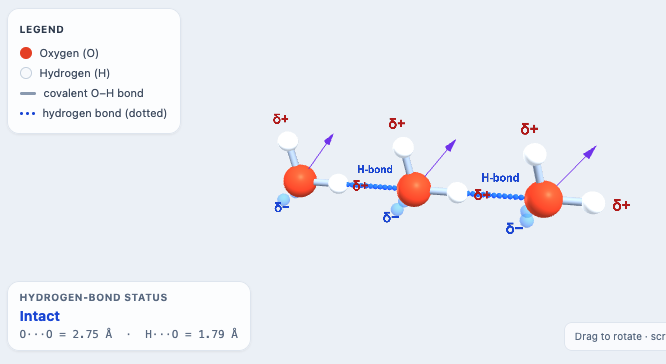
Describe how the polarity of water molecules results in hydrogen bonding. Draw 3 water molecules and use a dotted line to show where hydrogen bonds are formed.
Answer
Chemistry concept with clear spatial structure — building a 3D interactive model.
The 3D model is ready — drag to rotate it, then slide the O···O distance control and watch the blue dotted hydrogen bonds fade and break.
What you're looking at
Each of the three water molecules is drawn ball-and-stick: a red oxygen, two white hydrogens, joined by solid grey rods — those rods are the covalent O–H bonds inside a molecule. The blue dotted lines are hydrogen bonds, which form between molecules.
Step 1 — Why each O–H bond is polar
Oxygen's electronegativity is , hydrogen's is . Because O pulls the shared electron pair much harder, the electrons in the O–H bond spend more time near O. So the bond becomes polar covalent:
The charge is only shifted, not transferred — so this is not an ionic bond. Oxygen ends up partially negative , hydrogen partially positive .
Step 2 — Why the whole molecule is polar
Water's H–O–H angle is about — it is bent, not linear. Each O–H bond has its own little dipole, but because they sit at an angle, they don't cancel; they add into one net molecular dipole pointing from the hydrogen side toward the oxygen side . That net dipole is what we call a polar molecule. It's why water dissolves salts and why it has such a high boiling point.
Step 3 — Where the hydrogen bond forms
A hydrogen bond is the electrostatic attraction between:
- the hydrogen of one water molecule, and
- a lone pair on the oxygen of a neighbouring water molecule.
Notice in the model how the H sits almost exactly on the straight line joining the two oxygens — real hydrogen bonds are close to linear. In the chain of three molecules you can see two hydrogen bonds. In general each water can donate 2 hydrogens and accept 2 lone pairs, so it can form up to 4 hydrogen bonds — that's the tetrahedral network that makes ice expand and float.
Step 4 — How strong is it?
| Interaction | Energy |
|---|---|
| Covalent O–H bond | |
| Hydrogen bond |
A hydrogen bond is roughly 20–25 times weaker than the covalent bond inside the molecule. That's exactly what the slider shows: at the real liquid-water value the dotted lines are solid; pull past and they simply vanish — no covalent bonds were broken, only the weak intermolecular attraction.
Key concepts
- Polarity — unequal sharing of electrons creates bond dipoles.
- Bent geometry — the two bond dipoles fail to cancel, giving a net molecular dipole.
- Hydrogen bond — attraction between H and a lone pair on O; it is intermolecular.
- Strength hierarchy — covalent (intramolecular) hydrogen bond (intermolecular), so H-bonds break first.
Confusion points
- "Polar bond = ionic bond." No — in a polar covalent bond electrons are shifted (δ⁺/δ⁻); in an ionic bond they are transferred (full +/− charges).
- "The dotted line is a weak covalent bond." No — a hydrogen bond is a non-covalent attraction between two separate molecules; no electrons are shared between them.
- "The two O–H bonds add to give a big dipole regardless of shape." Only the bent shape leaves a net dipole; a linear arrangement would make the two bond dipoles cancel exactly (this is why is non-polar).
- "Hydrogen bonds form between two hydrogens." No — always H(δ⁺) to O's lone pair; the H···H side is repulsive.
Understanding check: Carbon dioxide, , has two polar C=O bonds, yet the molecule is non-polar. In one or two lines, explain why 's polarity cancels but water's does not — and therefore why cannot hydrogen-bond.
Related posts
Content on this page is provided by its publisher. SeekPrep is a technology platform and does not own or assume legal responsibility for user-uploaded or third-party materials. For copyright concerns, contact [email protected] — see our Terms of Service.