how so₂ turns into h₂so₃ when dissolved in water
Question
show me the process of how Sulfur dioxide turns into sulfurous acid when it dissolves in and reacts with water.
Answer
The kernel, schema, and generators are clear. Now let me inspect the template for the accent/label color handling and overall structure.
The template, kernel, and schema are clear. Now I'll build the reaction. SO₂ and H₂SO₃ aren't in the molecule library, so I'll register them in-memory in a dedicated build script, then drive the high-level path (atom_map + sympy balancing) exactly as the kernel validates.
Skill self-checks pass. Now I'll write the build script (registering SO₂ and H₂SO₃ geometries in memory, then using the kernel's high-level path with sympy balancing + atom-map bijection validation).
The kernel validated everything (sympy balancing, atom-map bijection, conservation S·1 O·3 H·2, bond diff). Now I'll verify the generated HTML: placeholder replaced, data island parses, and no structural issues.
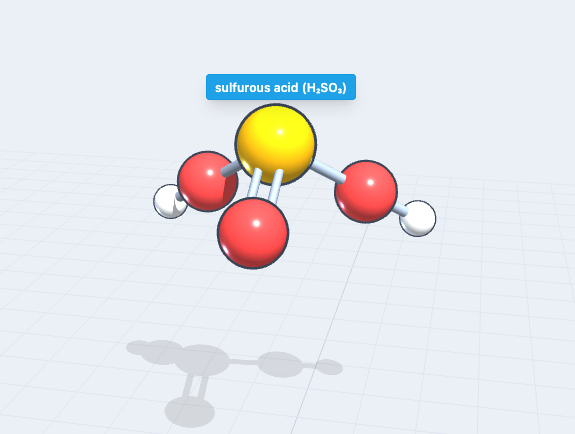
The interactive 3D demo is ready — drag the reaction-progress slider (or click steps 1–3) to watch the SO₂ molecule and water molecule collide, bonds break and re-form, and H₂SO₃ assemble atom by atom. The atom-conservation counter in the corner confirms nothing is lost or gained.
Here's what the animation is showing you, step by step.
What happens when SO₂ dissolves in water
Stage 1 — Physical dissolution (approach). Sulfur dioxide is a pungent gas produced whenever sulfur-containing fuels (coal, oil) or ores are burned. It dissolves readily in water — it's the most soluble of the common gases. At this stage nothing has reacted yet: the SO₂ molecule (sulfur yellow, two red oxygens, with bent shape and two S=O double bonds) just gets hydrated — surrounded by and bumping into water molecules. In the demo, the molecules are still in their reactant state: S=O and O–H bonds intact.
Stage 2 — Chemical combination (the transition). This is where the "turning into acid" actually happens. Watch the middle of the animation closely:
- The sulfur atom in SO₂ is partially positive because it pulls electrons strongly toward the two oxygens. The lone pair on water's oxygen is attracted to it.
- One O–H bond of water breaks, and simultaneously one of SO₂'s S=O double bonds loosens from a double to a single bond (the amber glow).
- Meanwhile two new bonds form (green glow): a new S–O bond to the water oxygen, and a new O–H bond as the freed hydrogen hops onto the other oxygen of SO₂.
Stage 3 — Sulfurous acid forms. The product is H₂SO₃, built from one S=O group and two S–OH groups. You can count the atoms before and after — 1 sulfur, 3 oxygens, 2 hydrogens — unchanged. That's mass conservation at the atomic level.
Three important details this demo makes visible
- It's a combination reaction, not a redox reaction. The sulfur keeps oxidation state +4 in both SO₂ and H₂SO₃: no electrons are transferred, atoms just re-bond. (The redox step in acid rain chemistry comes later, when H₂SO₃ gets oxidized to H₂SO₄ by oxygen in the air.)
- It's reversible. The ⇌ arrow matters: H₂SO₃ is unstable and easily decomposes back into SO₂ + H₂O, especially if heated or if SO₂ is bubbled out. This is why the reaction is written with ⇌, not →.
- "H₂SO₃(aq)" is a simplified label. In real rainwater there isn't a neat population of H₂SO₃ molecules. Dissolved sulfur dioxide exists as hydrated SO₂, and the acid partially ionizes as a weak diprotic acid:
Those H⁺ ions are what make the rain acidic (normal rain is already slightly acidic from CO₂, pH ≈ 5.6; acid rain from SO₂ drops to pH 4–5).
- Key concepts
- Combination reaction: one product built from two reactants; atoms conserved (1 S · 3 O · 2 H).
- Bond-level mechanism: water's oxygen lone pair attacks the electrophilic sulfur; one O–H bond breaks, one S=O π bond loosens, new S–O and O–H bonds form.
- Reversibility and weak-acid ionization: H₂SO₃ ⇌ H⁺ + HSO₃⁻ ⇌ 2H⁺ + SO₃²⁻ are the species that actually live in the solution.
- Acid rain link: SO₂ from fuel combustion → sulfurous acid → pH 4–5 rain.
- Confusion points
- H₂SO₃ (sulfurous, S +4, from SO₂) vs H₂SO₄ (sulfuric, S +6, from SO₃) — different acids, different sulfur oxidation state, different strength.
- "Acid rain is a redox reaction" — wrong for this step: S stays +4 throughout; oxidation to +6 only happens in a separate, later step.
- Writing → instead of ⇌ — H₂SO₃ decomposes back easily, so the reversible arrow is the honest one.
- Thinking the solution is full of "H₂SO₃ molecules" — the formula is convenient shorthand for a mix of hydrated SO₂ and ions.
Understanding check: In SO₂ and in H₂SO₃, the sulfur's oxidation state is the same value — work it out for H₂SO₃ (O = −2, H = +1), and then answer: is SO₂ + H₂O → H₂SO₃ a redox reaction? Why or why not?
Related posts
Content on this page is provided by its publisher. SeekPrep is a technology platform and does not own or assume legal responsibility for user-uploaded or third-party materials. For copyright concerns, contact [email protected] — see our Terms of Service.