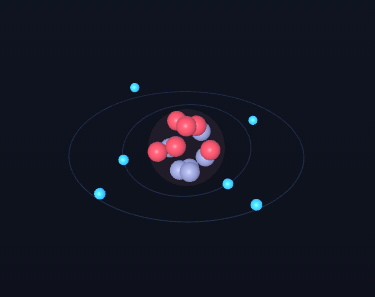
atomic structure with protons neutrons electrons and electron shells
Question
show Atomic Structure And Electrons - Structure Of An Atom - What Are Atoms - Neutrons Protons Electrons
The structure of an atom
An atom is built from exactly three particles, arranged as a tiny, dense nucleus surrounded by a vast, mostly empty electron cloud.
1. The nucleus — the heavy centre
About across (a femtometre) — roughly of the atom's diameter — yet it holds nearly all the atom's mass. It contains:
- Protons — charge , mass . The proton count is the atomic number , and it defines which element the atom is. Change the protons and you change the element itself.
- Neutrons — charge , mass , slightly heavier than a proton. Neutrons add mass and stability but don't change the element's identity. Same element with different neutron counts → isotopes.
Protons + neutrons together give the mass number :
Carbon-12 is : protons + neutrons.
2. Electrons — the light, spread-out cloud
Each electron carries charge and a mass of only — about 2000 times lighter than a proton. In a neutral atom, electrons protons. Lose or gain electrons and you get an ion — but the element stays the same, because protons didn't change.
Electrons occupy discrete energy levels (shells), labelled . Shell holds up to electrons:
| Shell | Max |
|---|---|
| (K) | 2 |
| (L) | 8 |
| (M) | 18 |
| (N) | 32 |
Electrons fill the lowest available shell first — exactly what the model shows as you raise and watch the shells populate outward. The outermost shell, the valence shell, drives all chemistry.
3. Why the numbers matter
- Atomic number → protons → the element.
- Mass number → protons + neutrons → the isotope.
- Charge → protons − electrons → whether it's an ion.
In the visual, set the element to sodium : the shells fill . That single valence electron is precisely why sodium is so reactive.
- Key concepts
- Proton number = element identity — alone names the atom; chemistry never changes it.
- Mass number — isotopes differ only in neutrons.
- Shells fill low-to-high energy — the valence shell governs reactivity.
- Neutral atom: electrons protons; ion: they differ.
- Confusion points
- Mass number vs. atomic mass — is a whole-number count of protons + neutrons; atomic mass (u) is the periodic table's weighted average (Cl , not ).
- Atomic number vs. mass number in notation — in , the bottom number is protons (), the top is protons + neutrons (). Easy to swap.
- Isotope vs. ion — isotopes change neutrons; ions change electrons. Both keep protons fixed.
- Shell capacity ≠ occupancy — is the maximum; argon's holds 8 even though the cap is 18.
Understanding check: An atom has 17 protons, 18 neutrons, and carries a charge. What is its mass number, and how many electrons does it have?
Work out the two counts separately — I'll confirm on your next reply.
Related posts
Content on this page is provided by its publisher. SeekPrep is a technology platform and does not own or assume legal responsibility for user-uploaded or third-party materials. For copyright concerns, contact [email protected] — see our Terms of Service.