finding domain and range of f(x) = -x² - 10x - 24
TL;DR: The domain of is all real numbers: . The range is since the vertex is at and the parabola opens downward.
Question
How do I find the domain and range for the quadratic equation: f(x) = -x² - 10x - 24?
Answer
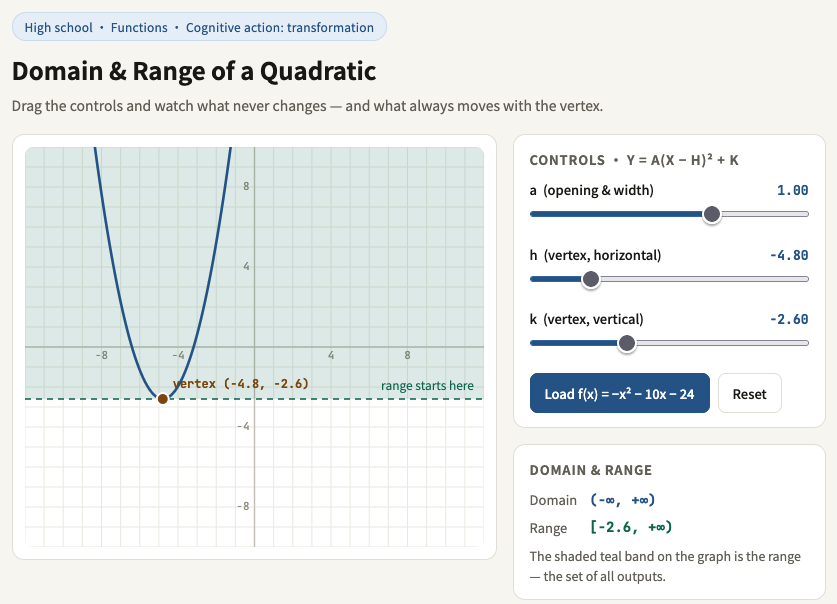
The interactive parabola is ready — open it and drag the k slider (or press Load f(x) = −x² − 10x − 24) to watch the shaded range band slide with the vertex while the domain refuses to budge.
Solving it step by step
Step 1 — Domain: can any break the rule?
The expression is a polynomial. You can square any real number, multiply it by , and add real numbers — nothing ever goes undefined (no division, no square root, no logarithm). So every real number is allowed:
Step 2 — Rewrite in vertex form by completing the square.
So , : the vertex is , and since the parabola opens downward.
Step 3 — Range: which outputs are actually reachable?
This is where the vertex form earns its keep. Because for every real ,
Equality holds exactly when , so is attained and it is the maximum. As runs off toward , grows without bound and drops toward . Every value below is hit somewhere by the continuous curve, so:
Quick check with the vertex point: . ✓
Key concepts
- Domain of a polynomial — every real is admissible, so it is always ; the domain question is only interesting when there is a division, root, or log.
- Vertex form — completing the square converts into this shape; the vertex is .
- Range of a quadratic — determined completely by the sign of and the vertex height . : ; : .
- Boundedness — is the whole reason the quadratic is bounded on one side; this is the algebraic engine of the range.
Confusion points
- Vertex -coordinate vs range bound — the range is governed by (the -value, here ), not by . Students often quote as the range because it is the "important number" they just computed.
- Sign flip when reading — shifts left by , so , not . The bracket shows , the vertex coordinate is .
- Domain vs range — the domain is the set of inputs (, horizontal), the range is the set of outputs (, vertical). The teal band in the tool is vertical extent — that is the range.
- Open vs closed endpoint — the maximum is achieved (at ), so the bracket at is closed: , never .
- "Opens up means range is positive" — the sign of fixes the direction of the unbounded end, not whether outputs are positive. Here the outputs are mostly negative; the ceiling is just .
Understanding check: A classmate solves and writes "range because the vertex is at ." Which number did they misuse, and what is the correct range?
Content on this page is provided by its publisher. SeekPrep is a technology platform and does not own or assume legal responsibility for user-uploaded or third-party materials. For copyright concerns, contact [email protected] — see our Terms of Service.